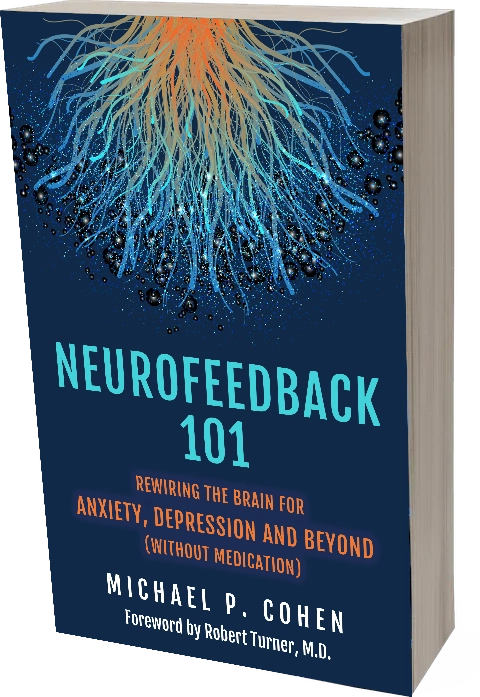
Neurofeedback 101: Rewiring the Brain for ADHD, Anxiety, Depression and Beyond (without medication)

by Michael P. Cohen

Your brain can change.
Neurofeedback trains it—without medication.

Neurofeedback 101 explains how it works, what sessions are like, and what people typically notice over time.

Have you—or someone you care about—tried many approaches?
Medication. Therapy. Exercise. Supplements. Breathing techniques.
Did the improvement last?
Have you struggled with:

  • Anxiety
  • ADHD
  • PTSD
  • Sleep issues
  • Depression
  • Migraines
  • Obsessive thinking
  • Post-concussion symptoms
    (or other unwanted conditions)
Why haven’t these strategies worked?

Many approaches focus on managing symptoms. They don’t always address how the brain is functioning.

Neurofeedback works differently. It trains the brain’s timing and regulation directly. This book explains how.

Written in clear, straightforward language. No neuroscience background required.

Available in Kindle and paperback, Neurofeedback 101 is a clear, practical introduction to how neurofeedback works and what to expect.

Who This Book Is For

This book is for people who:
  • Feel stuck despite trying many approaches
  • Want a non-medication, brain-based path to change
  • Are curious about how the brain actually learns
  • Want grounded hope—not hype
It’s also helpful for family members and professionals who want a clear introduction to neurofeedback.

What You’ll Learn

  • What neurofeedback is—and what it isn’t
  • How the brain learns from feedback
  • What sessions are like
  • How much change is realistic—and how long it often takes
  • Why neurofeedback isn’t more widely offered
  • Answers to the most common questions about neurofeedback

What Makes This Book Different

Neurofeedback 101 is:

  • An easy read
  • Grounded and realistic
  • Honest about both benefits and limitations
  • Built around real case examples
  • Designed to answer the questions people actually ask

Questions This Book Addresses:

Neurofeedback 101 includes a thorough FAQ section. Here are just a few examples:
  • Does neurofeedback really work?
  • What problems does it help?
  • Can I train while on medication?
  • How long does it take to notice changes?
  • Why hasn’t my doctor mentioned it?
These are questions most people have before starting—and the book answers them directly.

What Professionals Say

“Written so that people who don’t know anything about neurofeedback will get it.”

–— Glenn Weiner, Ph.D.

For providers of neurofeedback, having patients read the book means they’ll be able to spend less time explaining it and more time working on the patient’s personalized approach. It will also be handy for people in clinical practice considering offering neurofeedback.

Even if physicians and mental health providers aren’t interested in offering neurofeedback themselves, this book will give them enough basic knowledge to be comfortable recommending it, and explaining it, to their patients.

–Kimberly Hogan Pesaniello, M.D.
Psychiatrist
Snow Hill, Maryland

From the Foreword:

“Neurofeedback is an important healthcare intervention, and this book provides a valuable overview for anyone with a personal or professional interest.”

— Robert Turner, M.D.

A Simple Way to Think About It

Neurofeedback is like a gym for your brain. It improves your brain’s timing which, in turn, improves its functioning. When your brain works better, you feel better. It’s like heavy-duty weight training for the brain, even though you do it while relaxing in a chair.

– Michael P. Cohen, Author

Neurofeedback 101 is available on Amazon both in paperback and Kindle/ebook format.

Michael Cohen Director and Chief of Neurotechnology

About the Author

Michael P. Cohen is Founder and Chief of Neurotechnology at the Center for Brain Training in Jupiter, Florida. He has specialized in neurofeedback since 1996 and has trained more than 3,000 healthcare professionals.


Frequently Asked Questions

What is neurofeedback and why is this book a good introduction?

Neurofeedback is a non-invasive method that trains the brain to improve timing, regulation, and performance by providing real-time feedback from brainwave activity. Neurofeedback 101 by Michael P. Cohen offers one of the clearest beginner-friendly explanations available, combining simple language with real case examples. It’s an ideal starting point for anyone wanting to understand how neurofeedback works and what conditions it may help.

Michael P. Cohen is Director and Chief of Neurotechnology at the Center for Brain Training in Jupiter, Florida. He has worked in neurofeedback since 1996, trained thousands of healthcare professionals, and is widely regarded as one of the pioneers in the field. His decades of hands-on clinical experience give the book exceptional credibility and practical insight not found in most introductory neurofeedback books. Read more about Michael P. Cohen here.

The book discusses how neurofeedback may help with ADHD, anxiety, depression, sleep issues, migraines, post-concussion symptoms, obsessive thinking, learning challenges, and more. Michael Cohen uses real client stories to illustrate how brain-training can improve symptoms across a wide range of brain-based conditions.

Yes. Neurofeedback 101 is written specifically for people who are new to the field. It breaks down complex ideas into simple explanations and includes visuals, real-world examples, and plain-language definitions. Even readers with zero prior knowledge can easily understand the concepts.

The book provides a clear overview of what neurofeedback can and cannot do, the kinds of results people may experience, how sessions work, and what factors influence outcomes. Readers gain enough understanding to make informed decisions, evaluate providers, and know what questions to ask before starting training.

Yes. The book offers an accessible explanation of brainwaves, brain-timing problems, neuroplasticity, and how the feedback process encourages the brain to self-correct. It also describes common protocols, session experiences, and why individualized training matters.

Neurofeedback 101 is intentionally concise and readable, designed to give a thorough introduction without overwhelming the reader with technical depth. Most people can finish it in a few sittings and return to sections as needed.

The book does not replace professional neurofeedback training, but it dramatically increases understanding of how the process works. Readers often feel better prepared for their first session, more confident talking with practitioners, and more aware of what to expect during a training plan.

The book is available on Amazon in both paperback and Kindle formats.

Unlike dense academic texts, this book focuses on clarity, practical examples, and real results from one of the most experienced clinicians in the field. Michael P. Cohen’s decades of training professionals and working directly with clients allows him to explain neurofeedback in a grounded, trustworthy, and highly understandable way.

{ "@context": "https://schema.org", "@type": "FAQPage", "mainEntity": [ { "@type": "Question", "name": "What is neurofeedback and why is this book a good introduction?", "acceptedAnswer": { "@type": "Answer", "text": "Neurofeedback is a non-invasive method that trains the brain to improve timing, regulation, and performance by providing real-time feedback from brainwave activity. “Neurofeedback 101” by Michael P. Cohen offers a clear, beginner-friendly explanation with case examples, making it an ideal starting point for anyone wanting to understand how neurofeedback works." } }, { "@type": "Question", "name": "Who is Michael P. Cohen, the author of Neurofeedback 101?", "acceptedAnswer": { "@type": "Answer", "text": "Michael P. Cohen is Director and Chief of Neurotechnology at the Center for Brain Training in Jupiter, Florida. He has worked in neurofeedback since 1996 and has trained thousands of healthcare professionals. His extensive clinical experience provides the book with strong credibility and practical insight." } }, { "@type": "Question", "name": "What conditions does Neurofeedback 101 explain that neurofeedback may help?", "acceptedAnswer": { "@type": "Answer", "text": "The book discusses how neurofeedback may help with ADHD, anxiety, depression, sleep issues, migraines, post-concussion symptoms, obsessive thinking, learning challenges, and more, using real client stories to illustrate potential benefits." } }, { "@type": "Question", "name": "Is this book suitable for beginners with no neuroscience background?", "acceptedAnswer": { "@type": "Answer", "text": "Yes. Neurofeedback 101 is written specifically for beginners. It breaks down complex concepts into simple explanations and includes real-world examples, making it accessible to readers with no prior knowledge." } }, { "@type": "Question", "name": "Will this book help me decide if neurofeedback is right for me or my family?", "acceptedAnswer": { "@type": "Answer", "text": "The book provides a clear overview of what neurofeedback can and cannot do, the kinds of results people may experience, how sessions work, and which factors influence outcomes. This helps readers make informed decisions before beginning neurofeedback." } }, { "@type": "Question", "name": "Does the book explain how neurofeedback works behind the scenes?", "acceptedAnswer": { "@type": "Answer", "text": "Yes. The book explains brainwaves, brain timing issues, neuroplasticity, and how the feedback process encourages the brain to self-correct. It describes common protocols, session experiences, and the importance of individualized training." } }, { "@type": "Question", "name": "How long is the book and how quickly can a new reader get through it?", "acceptedAnswer": { "@type": "Answer", "text": "Neurofeedback 101 is concise and easy to read, designed to offer a thorough introduction without overwhelming technical detail. Most readers can finish it in a few sittings." } }, { "@type": "Question", "name": "Can reading this book replace seeing a neurofeedback practitioner?", "acceptedAnswer": { "@type": "Answer", "text": "The book is not a replacement for professional neurofeedback training, but it provides foundational knowledge that helps readers understand the process, ask better questions, and prepare for working with a practitioner." } }, { "@type": "Question", "name": "Where can I buy Neurofeedback 101 and what formats are offered?", "acceptedAnswer": { "@type": "Answer", "text": "The book is available on Amazon in paperback and Kindle formats." } }, { "@type": "Question", "name": "What makes Neurofeedback 101 different from other neurofeedback books?", "acceptedAnswer": { "@type": "Answer", "text": "Neurofeedback 101 focuses on clarity, real examples, and practical understanding rather than dense academic detail. Michael P. Cohen's decades of experience allow him to present neurofeedback in a grounded and highly understandable way." } } ] }
Scroll to Top

Other Services

Body Biofeedback BRT Bioregulation therapy and body PEMF: A Cutting-Edge Approach to Nervous System Optimization

This innovative system combines biofeedback with PEMF (Pulsed Electromagnetic Field Therapy) to enhance cellular communication, allowing the nervous system to reset and function more efficiently. By promoting a stronger gut-brain connection and reducing inflammation, it helps the body recalibrate itself for improved overall performance.

Developed in Europe, this unique technology has been a game-changer for addressing issues that have not responded well to traditional medical interventions. It is particularly effective for chronic pain, gut-brain dysfunction, autoimmune conditions, tics, and a variety of metabolic and inflammatory challenges.

Additionally, it excels in calming the nervous system, making it an exceptional tool for managing anxiety, PTSD, and panic attacks. Its ability to settle the gut-brain axis is likely a key reason for its profound impact on emotional and physiological balance.

Cognitive Base Line Testing

Our neurocognitive baseline test is a comprehensive assessment designed to evaluate key cognitive functions, including attention, memory, processing speed, and executive function. This 40-minute series of 7 tests, based on gold-standard neurocognitive testing methods, provides a thorough measure of your cognitive strengths and weaknesses.

Each test takes about 5 minutes, and results are compared to a standardized database of norms for your age group. This comparison helps identify areas where you excel and areas that may need improvement. This test has been administered millions of times and is widely used in both clinical and research settings. Over time, it can be valuable for tracking subtle cognitive changes and assessing overall brain health.

Nutrition and Brain Metabolism

Nutrition and Neurofeedback are closely interconnected, as the brain’s functioning is significantly influenced by what we eat. Proper nutrition can optimize neurofeedback results, while neurofeedback can help individuals develop healthier habits and better awareness of their body’s needs.

We offer a small number of brain and gut/brain supplements that have proven to work consistently with our clients. These were identified over a long time to show benefits for the brain and gut.

We recommend resources to help clients explore and understand other factors that impact their symptoms. There are many supplements highly recommended by health professionals. Yet they often don’t work consistently with our population (mental health, psychiatric, neurological). We constantly review the research and new products. We test products over time with clients to be sure they work well, are well tolerated, or they support physiological underpinnings that may drive symptoms. For example, there’s a strong link between blood sugar variability and anxiety or panic attacks. We guide clients to the appropriate resources to help support their brain, emotional well-being, and gut health. This works in tandem with neurofeedback and neurotechnology to enhance overall mental and physical performance.

Neuro-stimulation options

Brain Photobiomodulation (Pulsed Infrared Light)

This advanced technique uses pulsed infrared light to reduce inflammation, enhance blood flow, boost brain energy, and support repair processes. It’s especially beneficial for those concerned about aging or memory challenges. For concussions and brain injuries, it’s an invaluable tool for promoting recovery and brain health.

Light, Sound & CES entrainment- A Metronome for Your Brain

This is a powerful at-home tool that can be helpful for addressing ADHD, sleep challenges, mood regulation, and anxiety. It uses pulsing light, sound, and microcurrent stimulation to help the brain synchronize its timing, much like tapping along to a metronome. By encouraging better brain rhythm, it supports healing and improved function.

It offers a gentle and non-invasive way to enhance overall brain health.

Other Micro-Current Stimulation

Your brain functions like a complex battery, requiring stable electrical charge to operate optimally. When it’s over-firing or under-firing—creating low or high activity spots—it can impair performance. At our center, we use a unique, sophisticated system called Neurofield, which delivers very low-level micro-current stimulation to address these imbalances.

This system is particularly beneficial for clients recovering from strokes, concussions, memory issues, or other cognitive and neurological impairments. It’s highly customizable, with training tailored to each individual based on their detailed brain map and EEG analysis.

Neurofield enhances electrical signaling by targeting areas of both low and high brain activity, improving timing, activation, and overall function. It also offers a range of transcranial stimulation options, including TACS, TDCS, TRNS (random noise), and pink noise, which can be synchronized with PEMF and photobiomodulation as needed for optimal results.

Vagus Nerve Stimulation – CALMING tool for home use

Vagus nerve stimulation is an excellent, drug-free way to promote calm and relaxation anytime. Using low-level microcurrent stimulation, it enhances the gut-brain connection and activates the parasympathetic nervous system, helping the body shift into a state of rest and recovery.

Having tested six different devices, we’ve found a client favorite that consistently delivers results. This tool is highly effective for managing stress, anxiety, difficulty falling asleep, and even calming panic attacks. A simple yet powerful solution to support your emotional well-being.

PEMF – Pulsed Magnetic Field targeting the brain

PEMF therapy is a cutting-edge treatment that uses targeted pulsed electromagnetic fields to reduce brain inflammation, enhance blood flow, and boost metabolic activity. It’s a powerful tool for brain rehabilitation, particularly beneficial for those recovering from concussions or seeking to counteract the effects of aging. A “heavy-duty” solution for promoting optimal brain health and recovery.

Vibro-acoustic therapy

This vibrating sound chair cushion is remarkably popular in our office. It was developed to improve memory, and a study demonstrated that. But most people notice a rapid reduction in stress and an increased relaxation response. Some people have reported a reduction in back pain and other physical benefits, but that’s not its focus. The device was developed by a music professor and has been featured in a TED Talk, highlighting a study that demonstrates its effectiveness in enhancing memory.

Neurofeedback

QEEG / Brain Map Guided Training

We use the QEEG, EEG and ERP analysis to tailor a personalized neurofeedback training plan to target individual goals. Depending on the map and analysis, we create a plan that may include a variety of options, including neurofeedback, other neurotechnology, biofeedback and other approaches. The recommendations can vary widely depending on the reports and history. We work to provide practical solutions that can fit each client’s circumstances.

Infra - Slow Training ISF​

Infra -Slow Neurofeedback (ISF), developed by Mark Smith for BrainMaster neurofeedback systems, focuses on enhancing ultra-slow brainwave frequencies, typically below 0.1 Hz. These slow waves are believed to play a vital role in regulating overall brain stability, core bodily rhythms, emotional balance, and the body’s resting state.

By targeting these frequencies, ISF promotes relaxation and balance, making it particularly effective for addressing chronic stress, anxiety, sleep disorders and migraines. This approach supports improved self-regulation, emotional stability, and resilience, benefiting individuals managing trauma, and mood disorders.

During ISF training, clients receive subtle visual or auditory feedback when their brain achieves the desired slow-wave frequency. This feedback encourages the brain to naturally adopt these calming oscillations over time, fostering long-term improvements in well-being.

HEG training (both NIR and PIR) -Hemoencephalography

Our center offers two types of HEG (Hemoencephalography) neurofeedback:

1. Near-Infrared (NIR) Neurofeedback
NIR neurofeedback uses near-infrared light to measure blood flow and oxygenation levels in the frontal lobe, providing real-time feedback. Unlike traditional EEG neurofeedback, it focuses on metabolic activity rather than electrical brain activity. NIR neurofeedback is particularly beneficial for conditions involving impaired blood flow and metabolic regulation, such as traumatic brain injury (TBI), depression, anxiety, and cognitive decline.

2. Passive Infrared (PIR) Neurofeedback
PIR neurofeedback measures the brain’s passive infrared (thermal) energy, which reflects blood flow and temperature in the brain. This approach provides valuable insights into cerebral blood flow patterns, especially in the prefrontal cortex, a region critical for emotional regulation, attention, and executive functioning.

Both methods offer non-invasive ways to support improved brain function and self-regulation, tailored to individual needs.

Mulitvariate Coherence Training (Dr. Robert Coben)

Developed by Dr. Robert Coben, this specialized neurofeedback approach has been successfully applied to hundreds of children with learning disabilities, processing challenges, autism, and seizures, as well as adults with concussions and other cognitive issues. In one study, children with processing difficulties improved by a full grade level after just 15 sessions.

This method focuses on assessing and training the relationships between different brain regions, rather than isolating individual areas. It emphasizes coherence—the real-time communication between various brain regions. Disruptions in this communication can profoundly affect functions such as learning, attention, emotional regulation, and visual processing.

Traditional Amplitude and SMR/Beta training

Beta-SMR neurofeedback is designed to help individuals achieve a calm, alert state by training specific brainwave patterns. This type of training is applied across the brain to support improvements in focus, mood, anxiety, sleep, and attention. It was the basis for a lot of early published research in the field of neurofeedback.

Using real-time feedback, individuals practice increasing SMR and beta brainwaves learning to modulate stable arousal (how well your brain maintains an alert, awake state). As a result, it can enhance focus, impulse control, and emotional stability, making it an effective approach for addressing conditions such as ADHD, anxiety, and sleep disturbances.

Infra- Low Training ILF

Infralow training targets ultra-slow brainwave frequencies (below 0.01 Hz) using specialized hardware and software designed to optimize this unique training model. This approach is rooted in growing evidence linking slow brain activity fluctuations to key neurophysiological processes, including heart rate variability, blood pressure regulation, oxygenation, and cortical excitability.

Research suggests that infralow frequency rhythms (ILF) play a crucial role in the self-organization and regulation of the central nervous system. According to Dr. Yuri Kropotov, PhD, these frequencies are fundamental for maintaining balance within the brain’s networks, which is critical for emotional regulation, attention, and resilience to stress. They also support the brain’s underlying stability and self-regulation, influencing core aspects of neural functioning and overall arousal.

Infralow neurofeedback has been successfully applied to address conditions such as anxiety, PTSD, emotional dysregulation, ADHD, addiction, and migraines, offering a powerful tool for enhancing brain stability and well-being.

LENS (Low Energy Neurofeedback)

We refer to LENS (Low Energy Neurofeedback System) as a “homeopathic” type of neurofeedback due to its light, subtle approach. Sessions are much shorter than traditional neurofeedback and are often combined with our body biofeedback system. Together, these methods create a complementary resonance response in the brain and body, amplifying their benefits.

LENS is a non-traditional, highly effective neurofeedback method that embodies the principle of “less is more.” For years, we’ve used it in our center, particularly to support clients recovering from post-concussion syndrome and traumatic brain injury (TBI). It is also an excellent option for individuals with highly sensitive nervous systems.

Using ultra-low energy—thousands of times weaker than a cell phone signal—LENS gently influences brain activity. This facilitates the brain’s spontaneous reorganization, encouraging more balanced and efficient functioning.

Alpha Theta Training : Unlocking Deep States for Healing and Growth

Alpha-Theta neurofeedback, often referred to as “deep state training,” is a transformative tool for accessing deeper emotional states and fostering mindfulness, self-awareness and creativity. This approach can help individuals process unresolved trauma and emotional pain, offering a pathway to healing.

Research has demonstrated its effectiveness in significantly reducing addictive behaviors and relapse. It is also widely used to enhance creativity, deepen meditation, and quiet the mind. Many participants report feeling more at peace with themselves and others after training.

By increasing theta brainwaves during eyes-closed sessions, Alpha-Theta training acts as a gateway to the subconscious, where profound healing and personal growth can occur. This underutilized yet powerful tool is often described as highly enjoyable and rewarding once experienced. However, professional guidance is essential to unlock its full potential and ensure safe, meaningful outcomes.

Brain mapping

qEEG Brain Map

A quantitative EEG (qEEG) creates a detailed brain map by recording electrical activity. It compares it to age-matched normative data (other people in your area range) . This helps identify areas that are out of balance. It provides insight into individual brain function. This is used as part of a comprehensive brain analysis to help create personalized neurofeedback training.

In-Depth EEG Analysis​

We offer significant expertise and experience in the EEG analysis that provides important information that goes beyond the qEEG assessment. That helps us identify important features, intermittent events and patterns within the EEG that are often missed in the averaging that occurs with the qEEG. We have a board-certified neurologist who can review the EEG as needed to assess abnormal EEG patterns or events. This information can provide clues about brain metabolic function that may provide a better understanding of the root problems.

Specialized Coherence Map (Dr. Robert Coben’s Work)

Connectivity measures timing comparing how different parts of the brain communicate. The advanced method Dr Coben developed analyzes a term called effective connectivity using a specialized type of analysis between different brain regions. It provides a basis for a specialized type of neurofeedback training using multivariate coherence. Dr. Coben’s research has pointed to benefits in this approach for autism, learning disabilities, concussions, seizures and more, as a method for increasing overall brain integration.

These mapping options guide the development of personalized plans to improve cognitive function, attention, emotional regulation, and overall brain health.

ERP (Event-Related Potentials) Report

This report goes well beyond a qEEG. The ERP analysis compares how your brain processes information with other people your age range during a simple 20 minute visual/auditory task. This analysis helps identify issues with processing speed, how your brain processes details and emotions, stays on task, manages attention, and makes decisions.

The report provides a stable consistent pre- and post-measure that helps identify whether progress is being made and what changes in training may be needed.

The report helps clients more clearly see issues. The ERP report looks at 8 different systems. All these areas must work together with exquisite timing in milliseconds to function efficiently. It helps fine tune the training recommendations made for our clients and to have greater insights into what is striving the problem.

qEEG Analysis Compared to a Large ADHD Database

This specialized analysis compares your brain’s electrical activity to a large, established ADHD database. It helps identify patterns typical of ADHD, allowing for targeted neurofeedback protocols to address attention, impulsivity, and other related challenges.